DRAWING PRIZE 2025 WINNERS:
CONGRATULATIONS to David Jamieson
WITH HIS PORTRAIT TITLED
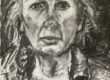
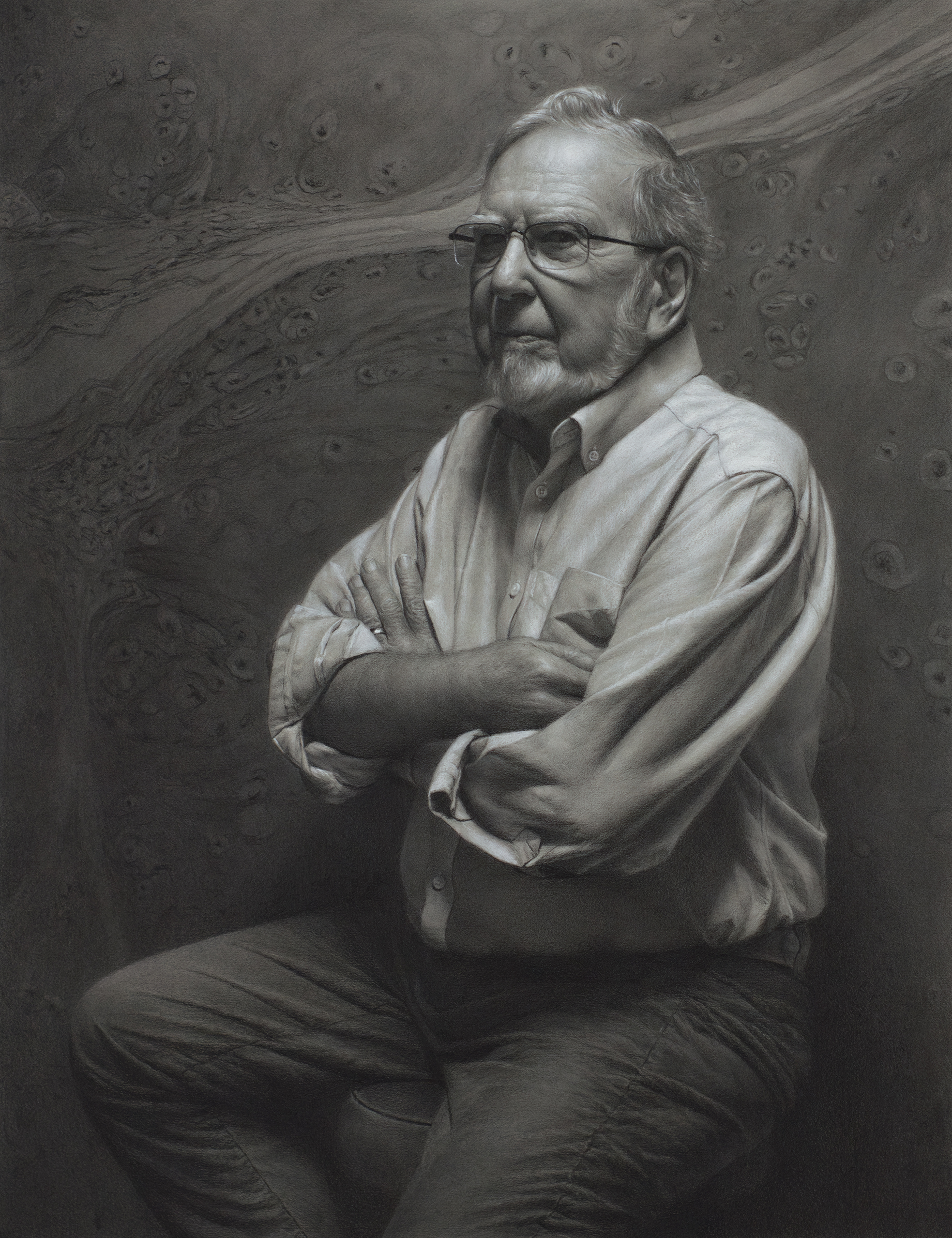
‘Pathologist – Portrait of Dr Maurice Jamieson’
Q. How long did your portrait take to make? Is there anything about the process you’d like to share?
It’s always difficult to be precise about how long I spend on a drawing since I don’t keep careful track of the hours I spend in the studio. But I can give you a time frame of about 6 months, from August 2024 to January 2025, between starting and completing the portrait. During that time, it was on and off my easel with varying frequency, depending on other deadlines, which is why a strict tally of hours is hard to estimate.
Regarding process, this piece was a bit of an experiment in using ink wash to tone paper by hand–a new experience for me. For this kind of drawing, where I use graphite and white pastel to describe form, I like to work on surfaces of a particular value, somewhere between 6 and 7 on the Munsell scale. I find this kind of ground makes for a good ratio of pastel to graphite, or what’s lighter than the paper vs. what’s darker. As it turns out, getting just the right value, color and consistency of tone with ink wash is a bit tricky, requiring much trial and error. I went through several sheets of paper before getting the surface I wanted.
Q. Is there anything about the sitter you’d like to share?
Here’s the statement for this portrait that I shared previously:
This portrait depicts my father, Dr. Maurice Jamieson (“Moe”), whose career as a pathologist in Canada spanned nearly four decades. Much of his work involved detailed analysis of tissue samples under a microscope, searching for signs of disease. The pathology slide in the background symbolizes how my father’s dedication to medicine shaped my understanding of him throughout my life. His work was never just a job; it was an integral part of his identity.
Though life has led us down different paths, separated by great geographical distance, the experience of working on this portrait became a kind of reunion. As his familiar gaze began to look back at me from the page, I found myself reflecting on his influence in my life–the example he set, along with his enduring patience and encouragement, as I made my own way in the world.
The most compelling portraits convey more than likeness to reveal something essential about both subject and artist. In this work, I’ve attempted to honor my father’s appearance and intellect, but also our shared devotion to professions that demand careful observation and patient attention to detail. As a dedicated physician who loved his work, he inspired me to find similar fulfillment as an artist. This portrait stands as both a testament to his influence, and an expression of deep love and gratitude.
Q.What is your background with portraiture?
My development as a portrait artist has grown largely from my long experience as a drawing teacher.
I began taking dra wing seriously after graduating university, when I moved to the United States to attend the New York Academy of Art in 1998. In New York, I was able to learn from several preeminent figurative artists of the time, and gained a solid footing in drawing, anatomy, and perspective, while being exposed to a wide range of artistic styles and preferences.
From there, I took a faculty position at a small art college in Chicago. I taught figure, portrait, and anatomical drawing to undergraduates for 5 years before opening an independent studio school, with my wife Melinda Whitmore, in 2006. I’ve been teaching portrait drawing at Vitruvian Studio for the past twenty years.
Teaching has been hugely valuable for me. It has provided the means to stay engaged with the fundamentals of drawing, improving my own skill set even as I help students develop theirs.
Q. Where do you take inspiration from?
The great artists of the past, of course, are obligatory viewing for any figurative artist. I’m particularly drawn to images with crisp drawing, soft light and deep spaces. The works of Johannes Vermeer, Vilhelm Hammershøi, Thomas Eakins and Andrew Wyeth come to mind. I also love the drawings of Ingres and Adolph Menzel.
But I find inspiration in more current sources, too. Contemporary film, photography– even product design and good retail display–can offer valuable cues for compositions, groupings and color schemes, juxtaposing different textures and local colors. Artists working in traditional forms needn’t look only to the past. It’s a big, beautiful world out there!
Q. Do you have anything exciting coming up?
Well, I’m currently working on my largest drawing to date–a full-figure standing portrait that includes multiple complex surfaces and textures. I should have it completed in a few weeks. Stay tuned!
And, of course, I’m always excited for my next class to begin. I’ll be teaching Still Life in Pastel, an online class at Vitruvian Studio, starting on November 5th! Here’s the listing: https://vitruvianstudio.com/live-streaming-classes/